A 10-inch round cake serves about 24 to 40 people, depending on how it is sliced. I can get roughly 24 slim wedding-style portions with 1-inch slices, or closer to 26 generous party servings at 1.5 inches wide.
Square shapes can increase that count by up to 45% since edge space is not lost to the curve. Adding a 10–15% buffer for uneven cuts and guests who may want seconds is advisable.
If you’re curious about how tiers, cutting style, or event type affect these numbers, I’ve provided a breakdown of the changes below.
10-Inch Cake Servings: The Quick Answer
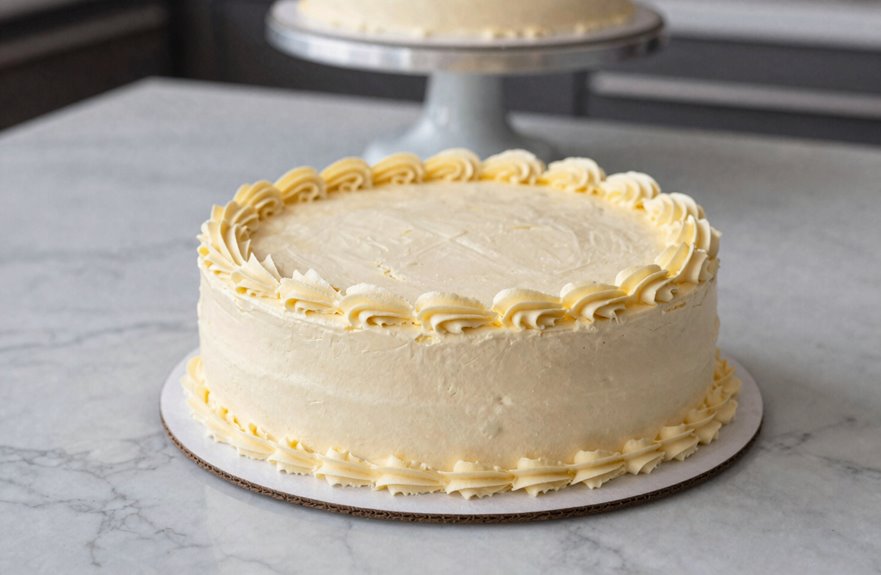
How many guests can I actually feed with a 10-inch cake? I can serve roughly 24 to 35 people, depending on how I slice it.
This serving size provides clarity without any guesswork.
When planning gatherings, I need numbers that help me focus on enjoying the moment rather than stressing over details. A 10-inch round cake yields about 26 generous party portions or tighter wedding-style slices for larger crowds.
I always include a bakers’ buffer of 10 to 15% extra, as it’s important to ensure there’s enough for everyone, especially for those who might want seconds.
Whether I’m creating a tiered centerpiece or keeping it simple, this cake size integrates well into my plans, ensuring no one is left out.
Party Slices vs. Wedding Slices: The Choice That Changes Everything
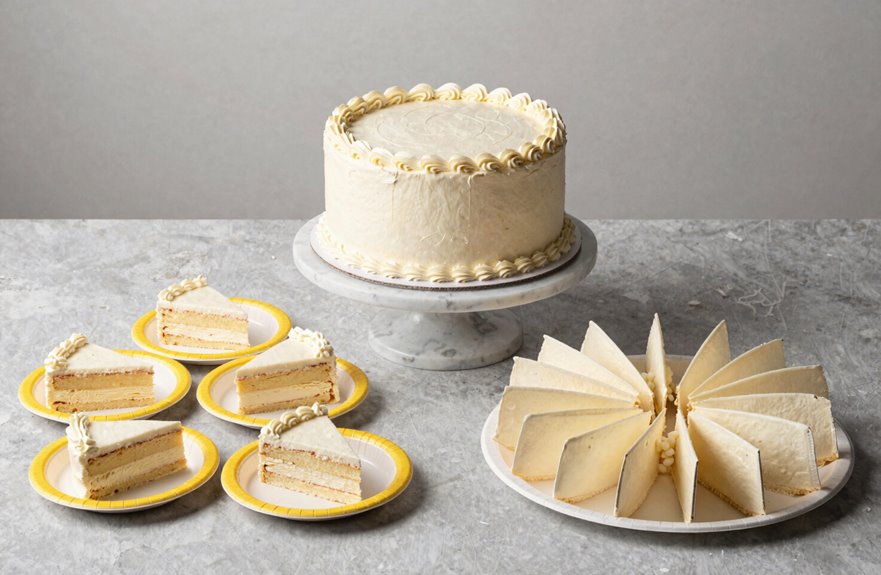
Why does the same 10-inch cake feed 24 people at one event and 35 at another? It all comes down to how you slice it.
Wedding servings are slim, measuring 1 inch wide by 2 inches deep, while party slices are 1.5 inches wide. That extra half-inch per slice significantly impacts your headcount.
Hosts should consider their audience before cutting. A formal affair requires neat, modest wedding portions, while a casual gathering calls for more generous servings.
That same 10-inch round yields roughly 24 wedding servings compared to fewer party-sized pieces, though the math changes with each additional tier.
I recommend adding 10–15% extra servings to account for uncertainty. Whether planning an intimate gathering or a grand reception, deciding on your slice style early ensures that all guests feel included and satisfied.
Single Tier or Stacked? When to Add 6-Inch and 8-Inch Tiers
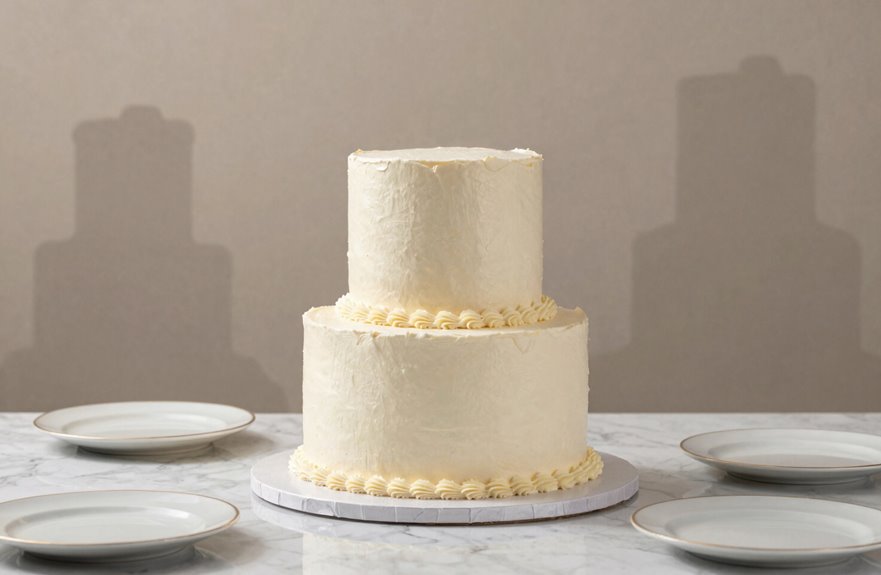
I’ll walk you through stacking basics first. A single 10-inch tier suits smaller gatherings, while adding 6-inch and 8-inch tiers allows you to serve over 50 guests and achieve that classic wedding cake silhouette.
It’s important to maintain distinct heights for each tier, typically 4 inches per tier, to prevent the 10-inch base from visually flattening against an 8-inch middle.
Additionally, decorators often use separators or extra-tall tiers to avoid a top-heavy appearance when the 10-inch tier is positioned at the top.
Tier Stacking Basics
Whether you’re feeding a small gathering or a full reception, the choice between a single tier or a stacked design often hinges on headcount and visual impact.
This guide will help you determine when stacking is appropriate for your celebration.
A single 10-inch cake serves roughly 26–40 party guests or up to 56 wedding guests, which works well for intimate affairs. As your guest list increases, adding tiers can enhance both capacity and presence.
Stacking 6-inch, 8-inch, and 10-inch tiers together significantly expands the number of servings, reaching 78–114 wedding portions or 52–72 party slices.
This classic three-tier arrangement provides a celebratory feel without overwhelming the event, offering a bakery-worthy look while ensuring all guests are satisfied.
Visual Balance Tips
Once you’ve settled on your guest count, the key decision becomes how your cake will look on the table. A single 10-inch tier feels intimate and unfussy, perfect for modest serving sizes.
When feeding a crowd, stacking can enhance the presentation. Adding a 6-inch tier on top creates subtle contrast, or you can build a graduated trio with 6-inch and 8-inch tiers beneath your 10-inch crown.
The trick is to avoid matching footprints. Pairing a 10-inch with an 8-inch below and a 6-inch on the bottom creates that desirable cascade without visual monotony.
Your serving size increases significantly, reaching approximately 52 to 114 portions depending on how you slice. Graduated heights provide a celebratory, balanced, and inviting look.
The Height Myth: Why 3 Layers Won’t Feed More People
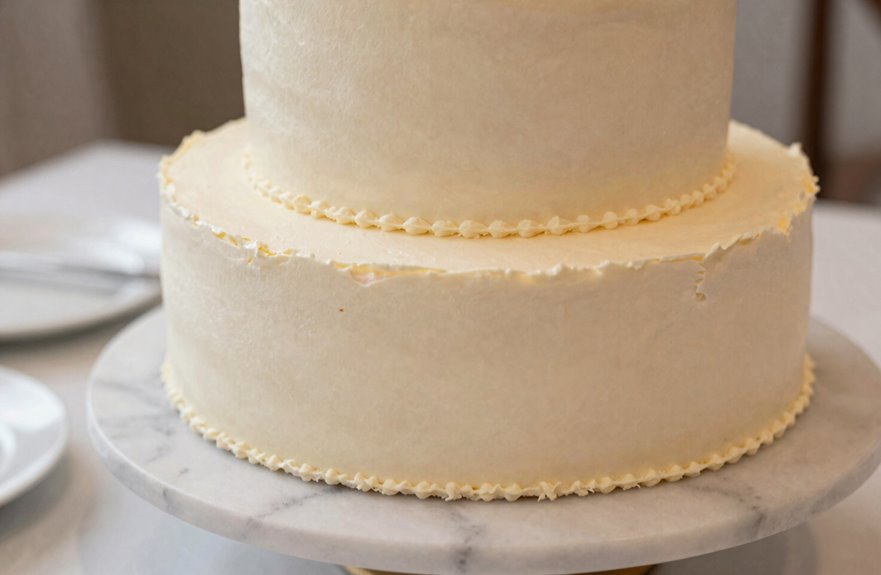
Why do so many of us assume that stacking another layer automatically means more slices? I’ve fallen for this too, thinking height equals abundance.
Serving count comes from surface area, not altitude. A serving chart confirms this; your 10-inch top stays 10 inches whether you’ve got two layers or three.
That extra height fattens slices but does not multiply them. I’ve watched bakers charge more for towering tiers while the actual yield remains the same.
We crave that impressive silhouette and a sense of generosity. However, unless you’re cutting smaller pieces or adding width, you’re not feeding extra guests.
True abundance means understanding what actually stretches—diameter and technique—not mere stacking. Let’s bake smarter together.
Grid Cutting vs. Wedges: Maximizing Your 10-Inch Cake Yield
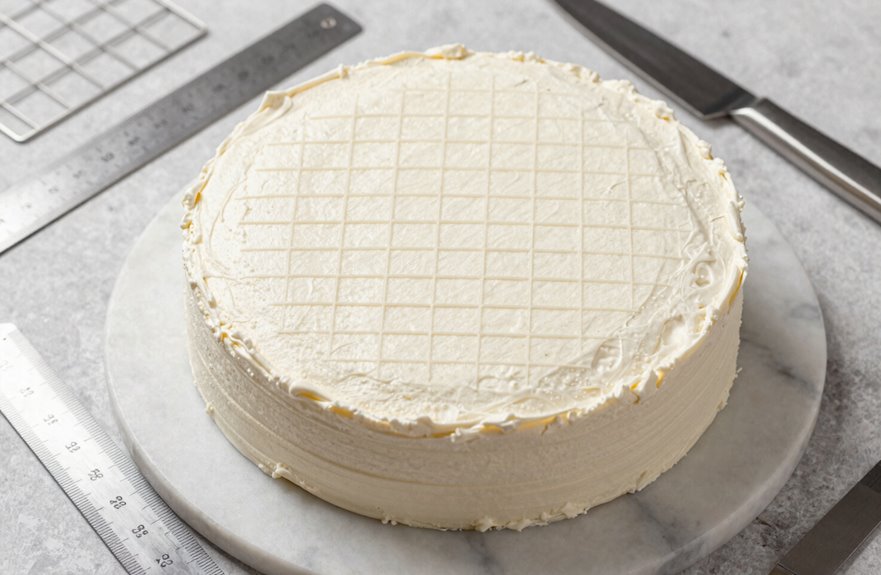
How do you maximize every last serving from a 10-inch round cake? Grid cutting changes everything.
Instead of traditional wedges that leave awkward end pieces, start 1.5 inches from the edge, carve a long slab, then slice inward in 2-inch widths and 1.5-inch steps. This method optimizes surface area without the waste that center-cutting creates.
You can yield roughly 26 wedding-sized portions or 22-24 party servings, sometimes even more than wedge cutting provides. The advantage of grid cutting is that it eliminates those uneven corner slices that are often undesirable.
This technique allows you to extend your cake further for your guests. Once you switch to grid cutting, you may find wedges to be less efficient.
Round vs. Square 10-Inch Cakes: Same Size, More Servings
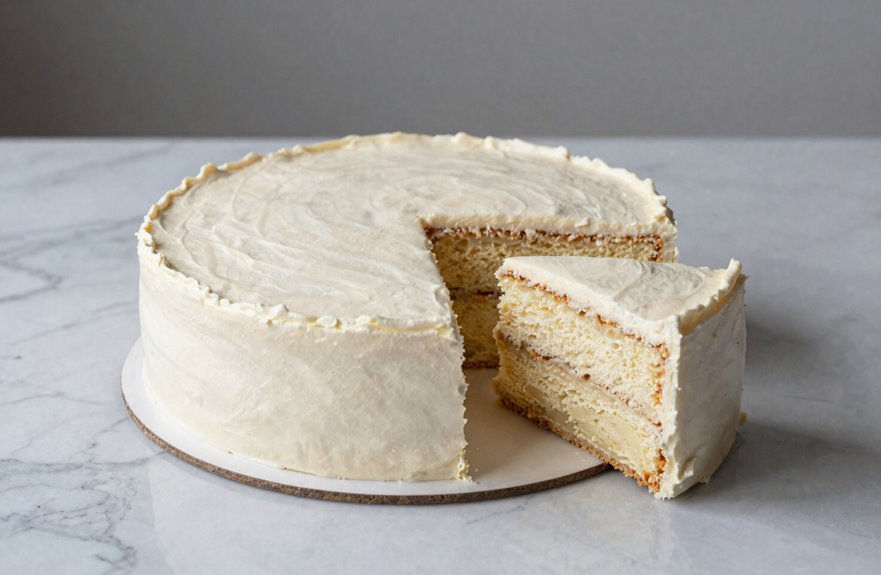
A 10-inch square cake serves significantly more guests than its round counterpart of the same size, as the lack of curved edges means less waste.
The square shape allows for cleaner grid cuts and roughly double the wedding portions compared to a round cake, especially when using standard 1-by-2 inch slices. I consider this efficiency when planning events.
Square cakes are ideal for tight budgets and large guest lists, while I choose round cakes for traditional aesthetics where the slight yield loss is acceptable.
Surface Area Advantage
Opting for a square 10-inch cake over a round one can significantly enhance your serving capacity. The surface area difference is clear.
A round 10-inch cake provides about 78 square inches, while a square 10-inch offers a full 100 square inches. This means you get more usable cake without any loss from curved edges.
Consider the implications for your celebration:
- Square cakes yield up to 45% more servings than identical-sized rounds.
- You get 28% more surface area (100 vs. 78 square inches).
- Wedding planners appreciate the efficiency; no edge waste means fewer emergency orders.
- Your guests spend more time enjoying the party instead of waiting for crumbs.
Height doesn’t affect the serving count; surface area does. I’m adding my 10–15% bakers buffer and appreciating the extra slices.
Cutting Efficiency Gains
Why does the same 10-inch cake yield more slices when it’s square? Curved edges waste space, while square corners maximize every inch.
When cutting, the round perimeter forces awkward trimmings, leading to loss of precious sections to scraps. In contrast, a square shape allows for clean, efficient rows.
The math confirms that, despite identical size, the reality differs. Studies show squares deliver 15–45% more servings.
I use tiered strategies as well, swapping rounds for squares in my 10-inch base. The added surface area means I can feed more guests without needing a larger cake.
Whether I’m center-cutting or starting from the edges, the square’s geometry enhances my efficiency. Same diameter, smarter shape; more plates and less waste.
Event Type Suitability
When planning an event, I consider whether a round or square 10-inch cake suits the occasion better. The shape affects my available servings and how generously I can feed my guests.
Here’s what I’ve learned about maximizing cake value:
- Round cakes typically yield 24-26 wedding servings, with their curved edges creating slight waste.
- Square cakes eliminate that perimeter loss, boosting my count to roughly 32 wedding servings.
- The same label size doesn’t mean equal yield; squares simply serve more people per inch.
- Guest experience improves with those extra 6 servings buffering my count.
I opt for square cakes when I want maximum servings without upgrading tiers. They allow me to welcome larger groups without the concern of running out.
10-Inch Cake Servings by Event: Birthdays, Weddings, and Casual Gatherings
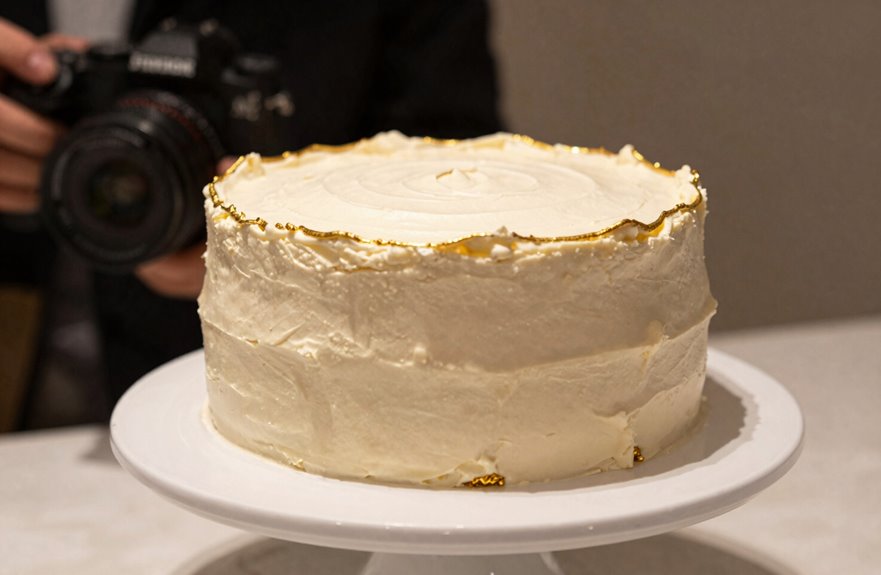
How much cake you’ll need depends on the occasion. Serving sizes vary significantly between events.
For weddings, I cut thinner 1×2-inch slices, which yield roughly 24 servings from a single 10-inch tier. Birthdays and casual gatherings require heartier party cuts at 1.5×2 inches, resulting in about 25–30 generous slices.
When I create tiered displays, that same 10-inch base contributes its proportional share without altering the surface area math.
Here’s how I break it down:
| Event Type | Typical Serving Count |
|---|---|
| Wedding (1×2″ slices) | ~24 servings |
| Birthday party | ~25–30 servings |
| Casual gathering | ~26 servings |
| Tiered cake component | Proportional to total |
| With 10–15% buffer | Add 3–4 extra servings |
I always pad my numbers slightly, as running short when everyone is gathered is not ideal.
What Bakers Actually Deliver: Real-World 10-Inch Cake Counts
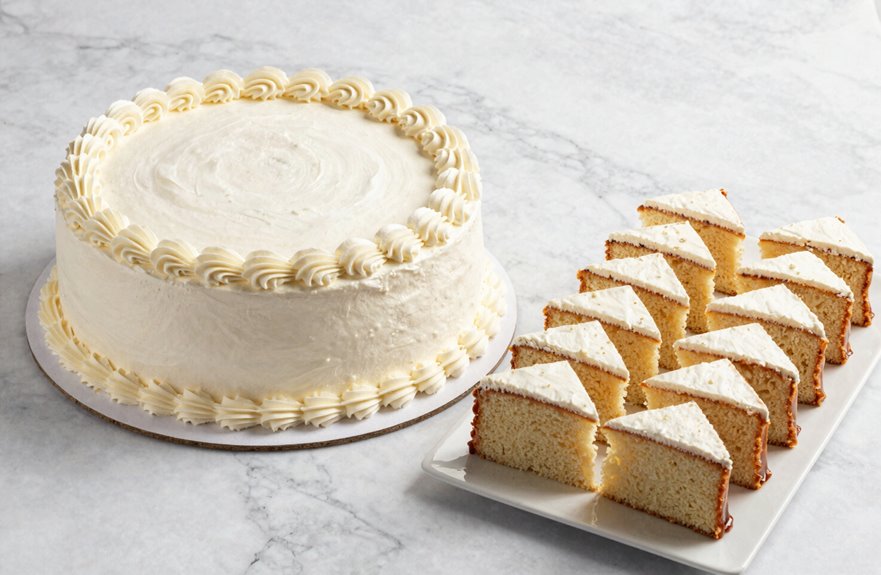
I want to show you what bakers actually deliver when you order a 10-inch cake, because the numbers on paper rarely match real-world results.
You’ll see how party and wedding serving counts differ dramatically, why stacking that tier into a three-layer arrangement changes everything, and what professional bakers estimate when feeding your crowd.
Let’s look at the actual yields you’ll get from your baker’s kitchen.
Party Versus Wedding Servings
Why does the same 10-inch cake feed fewer guests at a party than at a wedding? It comes down to slice size.
Wedding servings are slim 1×2 inch pieces, designed for seated guests who have already enjoyed dinner. Party servings are typically 1.5×2 inches because celebrations often lead to a desire for larger portions.
Here are key points to consider:
- Wedding servings stretch further—about 26 per 10-inch round.
- Party cuts reduce that to roughly 22 portions.
- Your slicing technique directly impacts final counts.
- Smart bakers add a 10–15% buffer for real-world generosity.
When planning, feel confident in choosing the right portions for your crowd. Whether opting for refined wedding servings or hearty party slices, understanding the differences will help ensure everyone is satisfied around your table.
Three-Layer Yield Impact
So what’s the real story when bakers stack three layers into that 10-inch round? I’ve observed this process closely, and here’s what I know from the craft.
A three-layer 10-inch cake fundamentally changes the yield equation. I’m looking at about 52 party servings from that height, or roughly 114 wedding portions when sliced thin.
The cake serving chart is essential in my kitchen, as each 10-inch layer contributes roughly 26 standard slices; however, that math shifts depending on your cut.
When building a tiered showpiece with 6-inch and 8-inch companions, I total every tier’s contribution separately. I also bake in a buffer, planning 10–15% extra for eager seconds and uneven knife work.
Real Baker Estimates
Those three-layer numbers look tidy on paper, but real-world baking demands a looser grip on the math. Serving sizes shift with every knife stroke, and many hosts panic when plates run short.
Here’s what bakers actually deliver:
- A single or two-layer 10-inch tier yields roughly 24 wedding servings.
- Adding that third layer and slicing halves boosts your count considerably.
- In 6+8+10 tiered setups, you’re looking at about 52 party servings or 114 wedding servings total.
- I always apply the Baker’s Buffer Rule; add 10–15% for second helpings and crooked cuts.
We belong to a craft where precision meets possibility. Rely on your experience, not just the chart.
Protecting Your Portions: How to Cut a 10-Inch Cake Cleanly
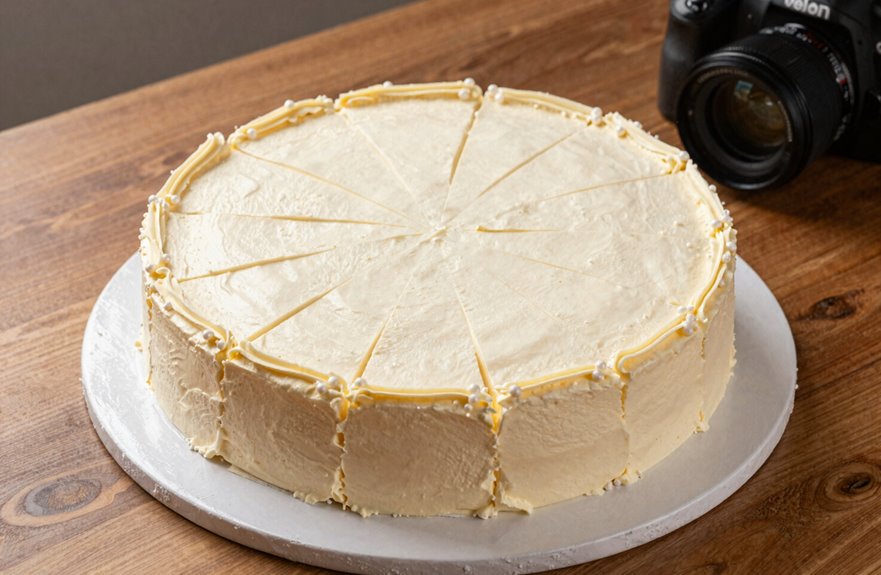
How do you keep every slice intact when a 10-inch cake holds 26 to 35 servings? Technique matters as much as size in any cake serving guide.
I always start at the edge and cut inward; center-cutting wastes precious portions. For higher yields, I square off rounds or choose square shapes; less perimeter means less waste.
Here’s what works:
| Method | Slice Size | Yield |
|---|---|---|
| Wedding cut | 1×2 in | 26–28 |
| Party cut | 1.5×2 in | 30–35 |
| Squared edge-to-edge | 1×2 in | 32–38 |
When building a display, I combine tiers. Using 10-inch, 8-inch, and 6-inch layers serves roughly 52–60 party portions together.
I always follow the Bakers Buffer Rule, planning 10–15% extra to account for uneven hands.
Leftovers, Dietary Needs, and Second Helpings: Planning for Real Guests
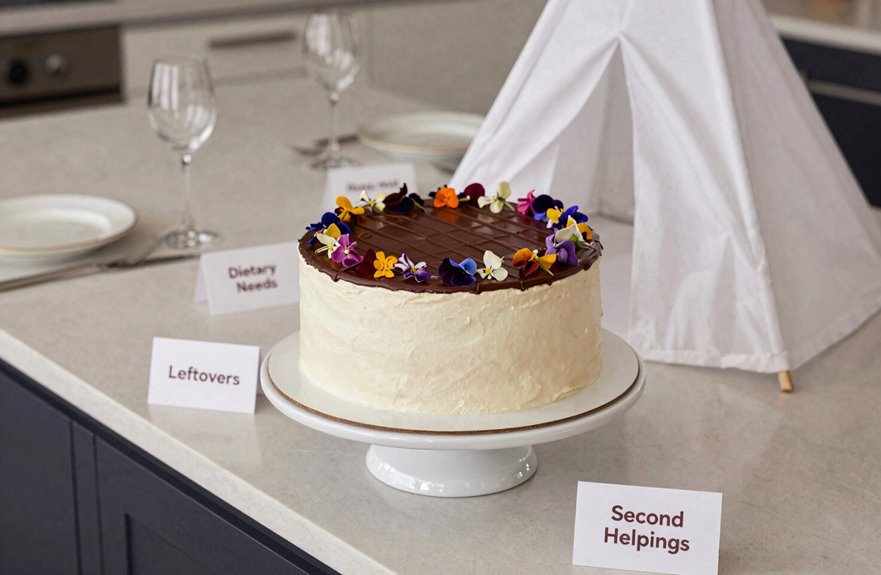
Where do the extra slices go when guests ask for seconds? They tend to disappear quickly, which is why I always plan for real appetites, not just headcounts.
The “Bakers Buffer Rule” has been useful; I size for my guest list plus 10–15% extra servings to cover second helpings and surprises. For 50–60 guests, I aim for 55–58 servings, often using tiered setups rather than one large cake.
Here’s what I watch for:
- Cut style changes everything—wedding slices (1×2″) stretch further than party slices (1.5×2″).
- Layer height multiplies servings without expanding diameter.
- Center-cutting technique minimizes waste and maximizes portions.
- Pairing strategies like adding cupcakes to a 12-inch base fill gaps elegantly.
Your guests will feel seen and well-catered to.